A Complete Beginner Guide to Quantum Computing, Qubits, and Algorithms
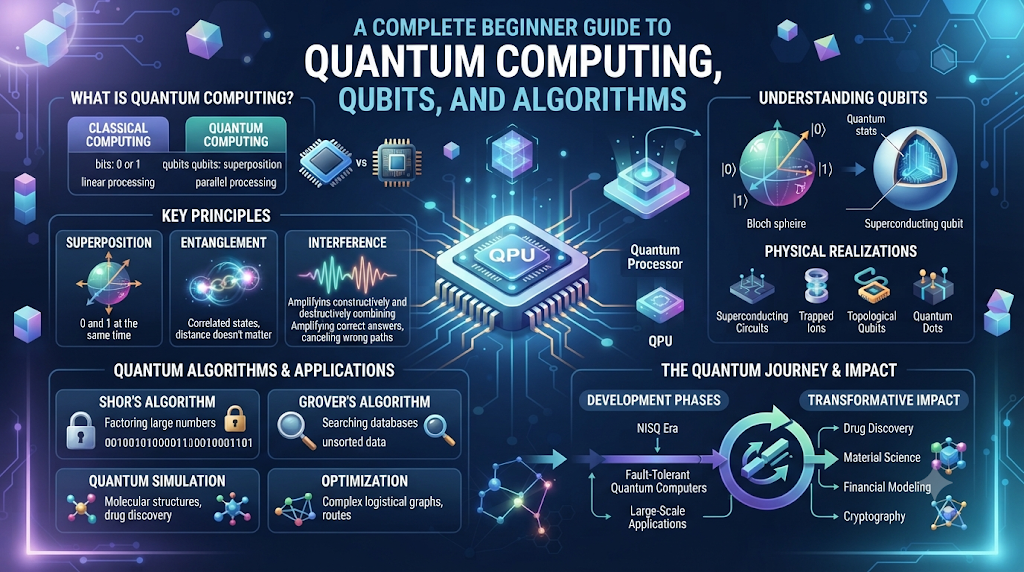
Opening the Door to Subatomic Computing Power
Across global research labs and software firms, engineers race to unlock a radically different type of machine. Traditional silicon chips process information by flipping microscopic electrical switches on and off. Quantum processors abandon that familiar binary path and tap directly into the strange behavior of atoms, electrons, and light particles.
Everyday devices solve math problems step by step using predictable electrical currents. Subatomic processors manipulate delicate particle states to navigate massive data landscapes in fresh ways.
Throughout this guide, you will build a practical understanding of how these systems operate. We cover qubits, quantum logic gates, circuit architecture, landmark algorithms, and next-generation encryption using clear, everyday examples. QuantumUting supports curious students, developers, and tech enthusiasts as they decode the quantum future through accessible tutorials and step-by-step articles.
Understanding What Makes Quantum Computing Unique
When people search for quantum computing for beginners, they often expect a faster version of a regular laptop. In reality, quantum computing represents an entirely separate method of processing information built on quantum mechanics. Quantum mechanics describes how nature behaves at the smallest measurable scales, where normal physical rules stop applying.
Picture a standard desktop computer as a massive grid of simple coin tosses that have already landed. Every coin shows either heads or tails. Now picture a quantum computer as a table full of spinning coins that blur together until someone stops them to look.
Scientists build these machines to simulate chemical reactions, discover new medicines, and model complex financial markets. Engineers still work daily to shield fragile quantum chips from heat and vibration. Learning these core principles gives you an early advantage as the technology matures.
Demystifying Qubits, Superposition, and Entanglement
Asking what is a qubit takes you straight to the heart of quantum information science. A qubit—short for quantum bit—acts as the basic building block of quantum data. While a standard computer bit holds a fixed 0 or 1, a qubit unlocks two remarkable physical behaviors:
- Superposition: A qubit holds a fluid blend of 0 and 1 simultaneously. Just like a coin spinning upright on a table, it carries the potential for both outcomes until an observer stops its motion.
- Entanglement: Two or more qubits form an invisible, unbreakable link. When you change the state of one entangled qubit, its partner reacts instantly regardless of the physical distance separating them.
Measuring a qubit ends its superposition immediately. The spinning coin falls flat, and the detector records a plain 0 or 1. By linking dozens of entangled qubits together, programmers process intricate mathematical relationships simultaneously.
Contrasting Quantum Processors with Classical Computers
Examining quantum computing vs classical computing clarifies where each machine shines. Your smartphone and office laptop rely on classical computing, which handles daily tasks like video streaming, gaming, and document editing with unmatched speed and reliability. Quantum processors serve as specialized scientific tools built for narrow, mathematically intense problems.
| Core Dimension | Classical Systems | Quantum Systems |
| Data Building Block | Standard bit (0 or 1) | Qubit (0, 1, or superposition blend) |
| Mathematical Basis | Boolean logic | Quantum mechanics |
| Control Operations | Classical gates (AND, OR, NOT) | Quantum gates (Hadamard, Pauli, CNOT) |
| Hardware Environment | Operates at room temperature | Requires extreme cryogenic cooling |
| Primary Strengths | Everyday apps, databases, web browsing | Molecular simulation, factoring, optimization |
Quantum hardware will never make your current laptop obsolete. Classical processors remain far cheaper and faster for routine software workloads. Future computing centers will combine both architectures, sending standard tasks to silicon chips and complex simulations to quantum processors.
Manipulating Quantum States Using Logic Gates
Classical computers run software by passing electrical pulses through logic gates. Quantum machines steer qubit states using specialized operations called quantum gates. Exploring quantum gates explained through plain examples shows how programmers direct subatomic data:
- Hadamard Gate (H): This gate pushes a resting qubit into superposition, creating an equal chance of measuring 0 or 1.
- Pauli-X Gate: This operation flips a qubit’s value, turning a 0 into a 1 or a 1 into a 0.
- Pauli-Z Gate: This tool shifts the rotational phase of a spinning qubit without altering its basic 0 or 1 probability.
- CNOT Gate (Controlled-NOT): This two-qubit gate flips a target qubit only when a control qubit equals 1, locking both particles into entanglement.
Every quantum gate works reversibly. Programmers can always run a gate sequence in reverse to restore the qubits to their exact starting conditions.
Assembling Qubits and Gates into Quantum Circuits
A quantum circuit connects individual qubits and logic gates into a structured program. You read a circuit diagram from left to right, much like notes across horizontal musical staves.
Walk through this simple quantum circuits tutorial to see a two-qubit program in action:
- Initialize the Qubits: Two qubits enter the left side of the diagram, both resting at 0.
- Apply Superposition: The top qubit passes through a Hadamard gate, entering a balanced mix of 0 and 1.
- Generate Entanglement: A CNOT gate links the top qubit to the bottom qubit, tying their fates together.
- Capture the Output: Measurement icons on the right end collapse the qubits and record standard 0s and 1s.
You do not need access to a cryogenic laboratory to run circuits today. Software engineers use Qiskit, an open-source Python framework, to build circuits and simulate quantum behavior right on standard home computers.
Understanding How Quantum Algorithms Solve Problems
While a circuit maps out physical gate operations, an algorithm provides the overarching mathematical recipe to solve a problem. Reading quantum computing algorithms explained clearly reveals why programmers cannot simply copy classical coding habits.
Because measuring a qubit collapses its superposition, quantum algorithms rely on wave interference. Developers design gate sequences that amplify the probability of correct answers while canceling out wrong outcomes.
Two famous algorithms showcase this clever design:
- Grover’s Algorithm: This search routine locates target items inside massive, unsorted datasets significantly faster than classical search methods.
- Shor’s Algorithm: This factoring routine splits giant numbers into their original prime multipliers.
Quantum algorithms accelerate only problems that feature specific mathematical symmetries. Everyday tasks like sorting email lists gain zero speedup from quantum interference.
Examining Shor’s Algorithm and Digital Encryption
Mathematician Peter Shor invented an algorithm that forever changed how security experts view computing. His method solves a classic math puzzle called integer factorization.
Factoring requires finding which prime numbers multiply together to produce a larger number. You can easily split 35 into 5 times 7 in your head. However, finding the prime factors of a 600-digit integer forces today’s strongest supercomputers to calculate for millions of years.
Studying Shor’s algorithm explained simply highlights why cybersecurity teams monitor quantum hardware closely. Modern internet encryption protects banking portals and private messages by hiding behind massive prime factors. A large, error-free quantum processor running Shor’s routine could crack those factors rapidly. Today’s early quantum machines lack the size to break internet security, giving engineers crucial time to upgrade global defenses.
Protecting Online Privacy with Post-Quantum Cryptography
Every online purchase and encrypted chat relies on public-key cryptography to block eavesdroppers. Standard encryption locks digital information behind math problems that classical computers cannot solve within a practical timeframe.
Learning post-quantum cryptography explained in plain words shows how security researchers safeguard future networks. Cryptographers actively build fresh encryption methods using complex mathematical lattices and multidimensional grids. Neither classical supercomputers nor future quantum machines can easily unravel these new puzzles.
Do not confuse post-quantum cryptography with quantum cryptography. Post-quantum security runs as standard software on existing smartphones, laptops, and cloud servers. Quantum cryptography requires specialized optical hardware that fires single photons through fiber-optic cables to detect tampering. Major technology organizations already roll out post-quantum software upgrades to protect sensitive data ahead of future hardware breakthroughs.
Exploring Real-World Applications Across Industries
Scientists and industry leaders actively test real-world applications of quantum computing across high-impact sectors. While most projects remain in research and pilot phases, these five fields lead the way:
- Drug Discovery: Pharmaceutical teams simulate molecular interactions to design targeted therapies without years of trial-and-error lab testing.
- Battery and Material Design: Chemists model new atomic structures to build lighter aerospace alloys and faster-charging electric vehicle batteries.
- Supply Chain Logistics: Transportation planners evaluate millions of delivery routes simultaneously to reduce fuel consumption and shipping delays.
- Financial Modeling: Risk analysts run complex market simulations to price derivatives accurately and detect subtle fraud patterns.
- Artificial Intelligence: Machine learning researchers test quantum circuits to speed up data classification and optimize complex models.
As engineers reduce hardware error rates and scale up qubit counts, these experimental pilots will transition into practical enterprise tools.
Steering Clear of Common Beginner Misconceptions
Exaggerated headlines often create confusion about what quantum technology actually does. Avoid these frequent myths as you study the field:
- Believing quantum machines speed up every task: Quantum processors accelerate specific math and simulation challenges, not everyday software.
- Thinking a qubit stores two classical bits: A qubit holds continuous probability amplitudes rather than two separate binary digits side by side.
- Confusing superposition with parallel brute-force computing: Quantum computers use wave interference to highlight patterns rather than checking every answer simultaneously.
- Assuming entanglement sends faster-than-light signals: Measuring entangled qubits reveals instant correlations, but physics prevents transmitting messages faster than light.
- Expecting classical computers to disappear: Future data centers will pair classical CPUs and GPUs alongside specialized quantum accelerators.
- Waiting to master quantum physics before coding: Programmers with basic Python skills can write and simulate circuits immediately.
- Mistaking early lab prototypes for finished commercial systems: Large-scale, fault-tolerant quantum computers remain an active engineering goal.
Following a Practical Roadmap to Learn Quantum Computing
Anyone curious about how to learn quantum computing can succeed by taking steady, manageable steps. You do not need a physics doctorate to write quantum programs. Work through these ten practical stages at your own comfort level:
- Brush Up on Core Math: Review high school algebra, basic probability, and complex numbers.
- Learn Linear Algebra Basics: Practice working with vectors and matrices, which represent qubit states and gate operations.
- Grasp Essential Quantum Concepts: Read beginner guides explaining superposition, measurement, and entanglement.
- Master Qubit Notation: Practice writing single-qubit and multi-qubit states using standard bracket notation.
- Study Core Logic Gates: Learn how Hadamard, Pauli-X, Pauli-Z, and CNOT gates transform qubit states.
- Read Circuit Diagrams: Trace small circuits on paper and calculate their final measurement probabilities.
- Practice Basic Python: Build familiarity with Python syntax, functions, and lists.
- Run Qiskit Simulators: Install Qiskit on your laptop and execute your first simulated quantum circuit.
- Build Starter Algorithms: Code introductory routines like Deutsch-Jozsa or basic Grover search examples.
- Engage with Developer Communities: Share your coding exercises, ask questions, and learn alongside fellow enthusiasts.
Short, consistent weekly practice sessions turn unfamiliar mathematical symbols into practical coding skills.
Advancing Your Skills with QuantumUting
Mastering an emerging technical field becomes much easier when you follow structured, jargon-free resources. QuantumUting serves as an educational platform dedicated to decoding the quantum future for curious learners worldwide. Students, software developers, researchers, and security professionals explore our guides to build clear foundational knowledge.
Our educational articles and tutorials walk you through qubits, logic gates, circuit design, and quantum algorithms step by step. You can also explore linear algebra essentials, Qiskit coding walkthroughs, and post-quantum security concepts at your own pace. Combining regular reading with hands-on simulator practice empowers you to build real confidence in quantum technology.
Resolving Frequent Questions from New Learners
What makes quantum computing different from regular computing? Quantum computing processes information using subatomic physics rather than standard electrical switches. This unique approach enables specialized machines to solve complex mathematical and scientific problems that overwhelm traditional computers.
How does a qubit work compared to a classical bit? A classical bit holds a single fixed value of either 0 or 1. A qubit uses superposition to exist in a fluid combination of both 0 and 1 until a measurement forces it to choose one outcome.
Will quantum processors eventually replace standard laptops? No, classical laptops and smartphones handle daily tasks like web browsing, video calls, and gaming much faster and cheaper. Quantum computers act as specialized co-processors for scientific modeling, optimization, and advanced math.
Do beginners need a physics degree to learn quantum programming? You only need basic high school math, introductory linear algebra, and beginner Python skills. Developers can write and test quantum circuits on laptop simulators without mastering advanced theoretical physics first.
What function do quantum gates perform inside a circuit? Quantum gates apply precise operations that change the state or phase of qubits. Programmers arrange these reversible gates in sequences to steer qubits toward a desired mathematical answer.
How does a quantum circuit execute a calculation? A quantum circuit feeds initialized qubits through a specific sequence of quantum gates from left to right. At the end of the path, measurement tools convert the final quantum states into readable 0s and 1s.
Why does Shor’s algorithm matter so much to cybersecurity? Shor’s algorithm factors enormous numbers exponentially faster than classical routines. Because current internet encryption relies on the difficulty of factoring large numbers, this algorithm drives global efforts to adopt quantum-resistant security.
Can today’s quantum computers hack encrypted bank data? Current quantum hardware lacks the qubit count and error correction required to break modern encryption. Security teams already deploy post-quantum cryptographic software to protect sensitive networks long before powerful quantum machines arrive.
Which real-world industries benefit most from quantum research? Pharmaceuticals, clean energy, global logistics, finance, and artificial intelligence show the strongest potential. Researchers use quantum prototypes to model new drugs, improve battery chemistry, and optimize complex supply networks.
How should a complete beginner start learning quantum computing? Begin by reviewing basic probability, vectors, matrices, and Python programming. Next, download a free framework like Qiskit and follow beginner tutorials to run simple circuits on your own computer.
Stepping Confidently into the Quantum Era
Quantum computing opens an exciting new chapter in science, software development, and digital security. By understanding how qubits, logic gates, circuits, and algorithms connect, you gain a clear view of how next-generation computers solve hard problems. Hardware engineers push physical limits forward every day, making now the ideal moment to build your foundational skills.
Keep experimenting with code simulators, stay curious, and tackle one new concept each week. Visit QuantumUting whenever you want clear explanations, coding tutorials, and practical guides across quantum information science. Start exploring today and take your first active step toward decoding the quantum future.
Leave a Reply